Airport Advertising in India: The Premium Outdoor Channel (2026 Guide)
India crossed 376 million domestic air passengers in 2024, the third-largest aviation market in the world, growing 9-12% annually. Airport advertising is the channel that reaches this travelling audience, and it consistently delivers the highest-quality demographic in Indian OOH.
This guide covers what airport advertising is, the major formats available, profiles of the top airports BookMyMedia operates in, and how to plan a premium airport campaign.
Why airport advertising is the premium outdoor channel
Three audience factors make airport advertising uniquely effective:
Income skew. Indian air travellers earn 2-4× the average urban income. Frequent flyers (those taking 6+ flights per year) skew further; the segment is dominated by corporate travel, premium leisure, and the senior-management decision-maker layer.
Dwell time. A typical airport passenger spends 60-90 minutes in the terminal: security, gate wait, baggage retrieval. That's 100-300× the exposure of a moving-vehicle hoarding (which gets read in 1-3 seconds). Brands with complex propositions (financial products, B2B services, luxury watches) often need this dwell time to land.
Repeat exposure. Frequent flyers see the same airport campaign 4-8 times per month, easily building 30+ exposures over a 3-month campaign. The exposure compounds into exceptional brand recall.
Airport advertising formats in India
Backlit panels
Lightboxes mounted on terminal walls, illuminated 24×7. The most common airport format. Available at:
- Check-in counters
- Security queue corridors
- Gate areas
- Arrival corridors
- Baggage claim halls
- International transfer zones
Backlit panels work well for any premium brand. The illumination, scale, and dwell time combination is uniquely effective.
Jet bridge panels
Branding inside the connector tube between gate and aircraft. Every passenger boarding sees this branding as they walk through. Most premium format because:
- 100% of passengers on every flight see it
- 45-90 second walk-through
- Exclusive sponsorship (no competing brands in the same jet bridge)
Baggage belt panels
Rotating panels above the baggage carousel. Passengers stand at the carousel for 10-20 minutes waiting for bags, with significant dwell time and no other distractions. Strong for brands that want sustained attention.
DOOH digital screens
LED screens at high-footfall locations within the airport: departure halls, food courts, gate areas. Dynamic creative, rotating between 8-12 advertisers per slot. Faster launches (3-7 days) and play-out reporting available.
Approach-road hoardings
Outdoor hoardings on the road leading to the airport. Reaches travellers in vehicles approaching the airport, typically a 5-15 minute exposure window depending on traffic. Pairs well with terminal inventory for reinforcement.
Trolley branding & pillar wraps
Smaller-format inventory at major airports. Branded baggage trolleys carry the message through the terminal. Pillar wraps cover structural pillars in the terminal hall. Lower cost per impression than backlit panels but more limited inventory.
Top Indian airports we operate in
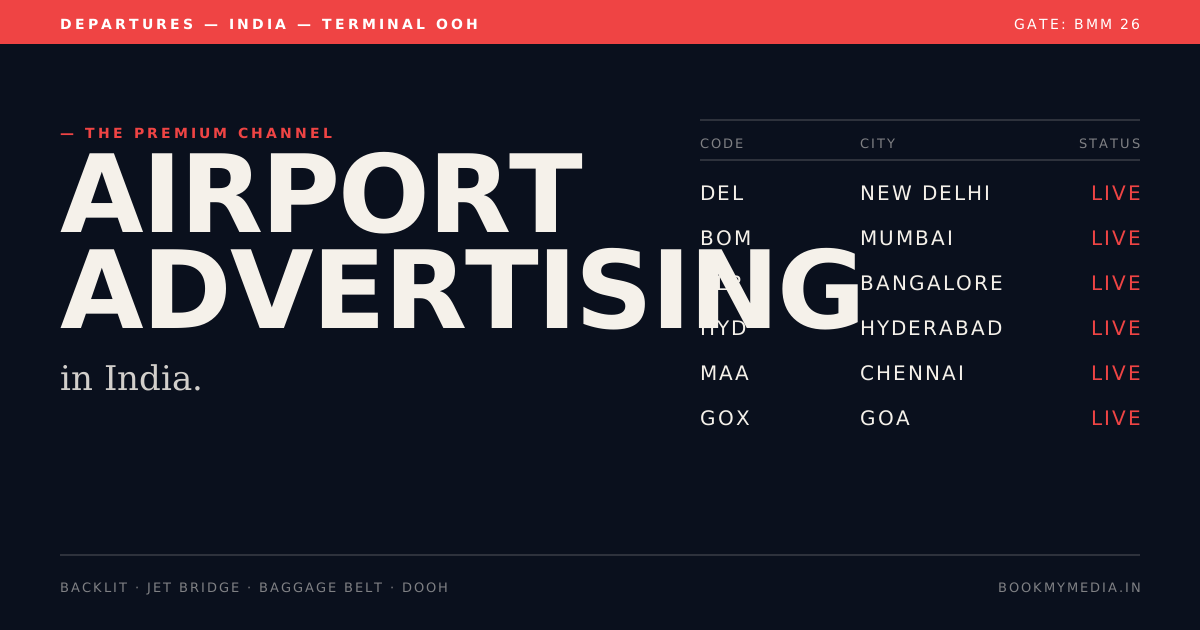
Delhi (IGI) | Indira Gandhi International Airport [DEL]
India's largest airport by passenger traffic, with over 73M passengers in 2024. Terminal 3 handles international and full-service domestic; T1 and T2 handle low-cost. Premium inventory concentrated in T3 international departure/arrival areas + the airport metro express station. Strong for premium brands, luxury, financial services, and government tourism campaigns.
Mumbai (CSMIA) | Chhatrapati Shivaji Maharaj International Airport [BOM]
Second-largest airport by traffic, with over 49M passengers in 2024. T1 (domestic) and T2 (international + select domestic) are physically separate. T2 is one of the most-awarded airport terminals globally for design. Premium audience skews business + entertainment-industry. Strong for premium brands, hospitality, banking.
Bangalore (KIA) | Kempegowda International Airport [BLR]
India's third-largest aviation hub, with over 37M passengers in 2024. New Terminal 2 has substantial DOOH and premium backlit inventory. Tech-sector business travel dominates the audience. Strong for enterprise software, business school programmes, hospitality, and luxury.
Hyderabad (RGIA) | Rajiv Gandhi International Airport [HYD]
Over 25M passengers in 2024. Single integrated terminal serving both domestic and international. Audience: IT corporate (HITEC City corridor), pharma corporate, government and bureaucratic travel. Strong for B2B services, financial products, premium consumer.
Chennai (MAA) | Chennai International Airport
South India's major international gateway, with over 22M passengers in 2024. T2 (international + select domestic) is the newer terminal with premium inventory. Audience: south India business travel, Middle East / Southeast Asia international, Tamil-speaking diaspora.
Kolkata (CCU) | Netaji Subhas Chandra Bose International Airport
Eastern India's primary hub, with over 19M passengers in 2024. Single integrated terminal. Growing international traffic (Gulf, Southeast Asia). Strong for brands targeting the eastern Indian market.
Goa (Manohar International) | GOX
New airport (operational 2023) serving the high-volume leisure traveller audience visiting Goa. Smaller terminal but higher dwell time (leisure travellers arrive 2-3 hours before departure). Strong for luxury, hospitality, travel-adjacent brands.
Pune, Ahmedabad, Coimbatore
Tier 2 metros with growing business and leisure traffic. Smaller terminals but lower per-panel rates make them efficient for brands targeting specific regional audiences.
Chandigarh, Indore, Lucknow
Northern and central regional hubs. Strong for state-specific government campaigns, regional consumer brands, and education sector advertising.
How to plan an airport advertising campaign
1. Define the audience first
Premium B2B → backlit panels in gate areas at Delhi/Mumbai/Bangalore + DOOH at Hyderabad/Pune.
Premium consumer → backlit + jet bridge at top 3 airports + baggage belt at all major terminals.
Regional / state → terminal of the relevant city's airport + approach-road hoardings.
Leisure / lifestyle → Goa, Bangalore T2, Mumbai T2, Delhi T3 international.
2. Pick formats by objective
| Objective | Best formats | | --- | --- | | Maximum reach | Backlit panels in arrival/departure corridors | | Exclusive premium impression | Jet bridge panels (one brand per jet bridge) | | Long dwell-time messaging | Baggage belt panels | | Dynamic creative or short campaigns | DOOH digital screens | | Reinforcement before terminal | Approach-road hoardings |
3. Plan 4-8 weeks of lead time
Airport campaigns need longer booking windows than street OOH because:
- Airport authority approvals (additional review cycle)
- Installation during off-peak operating hours
- Creative review by airport + airline + sometimes brand
Standard timeline:
- Week 0: Brief + site shortlist
- Week 1-2: Quote, booking confirmation, authority approval submission
- Week 3-4: Creative review and approval
- Week 5-6: Production
- Week 7-8: Installation (overnight, during low-traffic windows)
- Live thereafter
4. Budget realistically
Indicative range bands for major airport formats:
| Format | Range per month per panel | | --- | --- | | Backlit panel (Delhi/Mumbai T2/T3) | ₹8L – ₹25L | | Backlit panel (Tier 2 airport) | ₹2L – ₹8L | | Jet bridge sponsorship | ₹15L – ₹40L per jet bridge per month | | Baggage belt panel | ₹4L – ₹15L | | DOOH screen slot | ₹2L – ₹10L per month for 8-hour rotation |
For exact rates and inventory availability, request a quote. See our airport advertising service hub for the full overview.
What kinds of brands advertise at Indian airports?
Premium and aspirational categories dominate:
- Financial services: banks (HDFC, ICICI, SBI premium), credit cards (Amex, premium cobrand cards), wealth management, insurance
- Automotive: luxury (Mercedes, BMW, Audi, Lexus), premium (Volvo, Toyota Camry tier), and increasingly EV brands
- Real estate: premium residential, commercial leasing, large infrastructure projects
- Travel & hospitality: hotels (Marriott, Taj, Oberoi tier), airlines, tourism boards
- B2B services: consulting (BCG, McKinsey, Deloitte advertising for brand and talent), enterprise software, business school programmes
- Luxury retail: watches, jewellery, fashion houses
- Government: state tourism, central-government schemes, defence
- Healthcare: premium hospitals, medical tourism
Frequently Asked Questions
What's the difference between airport advertising and regular OOH?
Three differences. (1) Audience: airport travellers skew higher income and are highly likely to be decision-makers. (2) Dwell time: 60-90 minutes in terminal vs 1-3 seconds passing a hoarding. (3) Cost: airport rates are 2-3× equivalent street OOH but the audience quality multiple is even larger.
Which Indian airports have the best advertising ROI?
For premium B2B and luxury: Delhi T3 and Mumbai T2 lead by audience quality. For maximum reach: Bangalore (the highest-volume single terminal in India after Delhi T3). For regional campaigns: the airport in the target city always outperforms multi-airport coverage for the same budget.
Can I book just one airport, or do I need a multi-airport package?
Single airports work fine. Many brands book a single airport, typically Mumbai or Delhi, for a 3-6 month sustained campaign at premium formats. Multi-airport packages are usually only relevant for nationwide brand-awareness pushes.
How long should an airport campaign run?
Minimum 1 month (some packages enforce this). For brand-building, 3-6 months is the sweet spot, long enough for frequent flyers to see the campaign 12-20+ times, building strong recall.
Are airport ads expensive compared to street hoardings?
Per-panel: yes, 2-3× more expensive. Per quality-adjusted impression: usually comparable or better, because the airport audience is more valuable and the dwell time is much longer. Brands with premium positioning consistently say airport advertising delivers stronger brand equity per rupee than equivalent street OOH.
What creative formats do airport DOOH screens accept?
Most accept 10-30 second video creative (MP4, H.264) and static images (PNG, JPG). Resolution varies; typical specs are 1920×1080 or 1366×768. We provide exact spec sheets at booking.
Do you handle creative for airport campaigns?
Yes. We offer creative adaptation (taking your brand assets and producing airport-format creative) and full creative concepting on request. Premium airport creative often involves higher production values than street OOH, appropriate for the premium audience.
Plan a premium airport campaign for your brand. See our airport advertising service hub for full details, or request a custom quote. Bookings typically need 4-8 weeks lead time.